
Phys.io
- Role
- 3D generalist, hero assets; UX/UI with the group
- Audience
- Year 1–2 medical students, lecturers
- Team
- 4 when I joined
- Tools
- 3ds Max, Unity, Photoshop, Substance
- Platform
- Meta Quest 2 (VR)
- Timeline
- Joined early; MVP demoed Aug 2023; one update after
- Status
- On hold
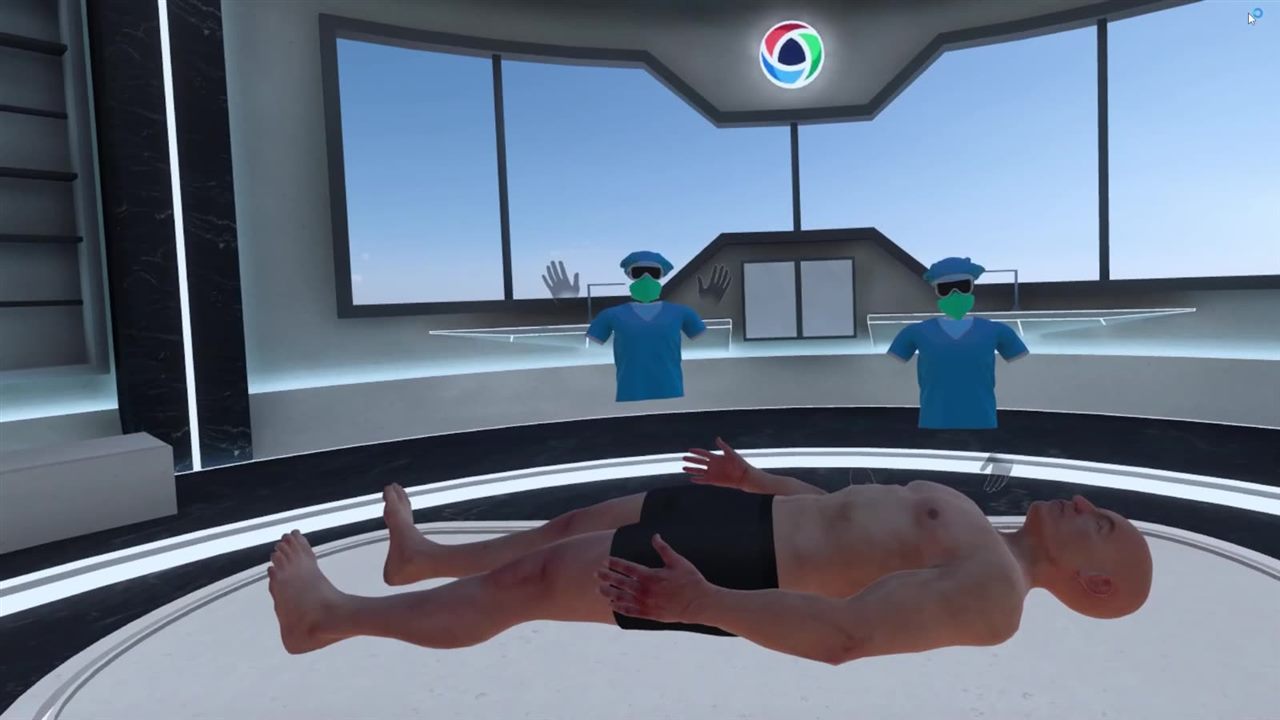
I've been into anatomy for a long time, as a fan of forensic and science shows and films. When Innoveam showed me Phys.io, a VR app for teaching anatomy together, I saw a chance to actually learn it, hands on. That's what pulled me into Innoveam.
The problem
Anatomy is taught on cadavers, and cadavers are hard to get. There are ethical questions, supply is short and the cost is high. So one cadaver is shared across classes, many students, many sessions, and it wears a little more with every session. Lab sessions are short. Some students never get their turn to handle it.
Phys.io is meant to fill that gap: a body that doesn't wear out, that every student gets hands-on time with, and that a group can work on together.
Building it meant three things. A body real doctors and lecturers would sign off on. Running in real time. Several students exploring it at once. Those three pull against each other. More anatomical detail means heavier meshes and rigs. Heavier rigs fight real-time. And a model several people can handle at once needs an interaction model that doesn't collapse.
What Phys.io is
An in-house Innoveam VR platform for medical universities, built with medical educators for the first- and second-year anatomy syllabus. Multiplayer, a body atlas, teaching tools and a custom LMS, on Meta Quest with hand tracking, so your hands stay free like they would in a real lab. My part: the body, its layers and the rig.
My role
I joined at an early stage of the project. Part of why Innoveam hired me: they needed a rigger and animator for the weight-bearing rig in the first vision.
- 3D generalist on the hero assets: the human body, the skeleton and every anatomical layer. Modeling, texturing, rigging, animation.
- I built the rig and the muscle deformation, and set up the IK in my 3D software. A separate programmer handled the Unity integration and interaction code.
- UX/UI as part of a group: interaction flow design, and testing with users and educators.
It ran for over a year, in phases. Version 1 and the MVP we took to MAAES look very different.
Where I started: the arm rig
The atlas I inherited was simpler, carried over from a previous project. I started with the arm, as a rig demo for IK and a pulling test. The brief said "rig as detailed as possible." So I went all out, upper arm to fingertips.
Hooked into the full-body system, it was far too heavy. It tanked Unity in testing.
The fix: fewer bones, simpler weight painting, less rig complexity overall. Then I matched that level across the whole body rig.
Getting the anatomy right
Meanwhile I was studying anatomy on my own, and our subject matter experts (SMEs), practising doctors who also lecture, kept sending feedback. Both said the same thing: the old atlas was missing a lot. So I compared the anatomy models out there and found an affordable base to build on.
The base got the big muscles and structures mostly right. Not everything. There was still a lot to fix, add and update: minor muscles, missing bones, nerves on the wrong path, proportions, topology rebuilt for deformation and clean layer separation, and proper medical terminology on every label.
I checked it two ways, back and forth. My own research: medical texts (Atlas of Human Anatomy), online sources, a few anatomy apps side by side, even anatomy journals. And many review sessions with the SMEs. I've lost count of the passes. Hands were the most complex, then legs, then the back.
As part of building this project, I had the rare opportunity to directly observe cadaveric anatomy, seeing real muscle structure firsthand. It was a sobering, eye opening experience that sharpened how I approached the model's accuracy. It also shaped the later scene design: how students actually move around a dissecting room.
Regions and layers
The model breaks down two ways, the same two ways anatomy is taught: regional and systemic.
Regional first. In a real lab, students split into groups, each at a station with a different region of the body ready to study, and rotate through.
Phys.io takes that a level deeper. Each region splits into sub-regions: the upper limb separates from the trunk, then splits into upper arm, forearm and hand. Each student detaches the exact area they want to study. The whole hierarchy, region down to sub-system, follows the syllabus and its learning outcomes.
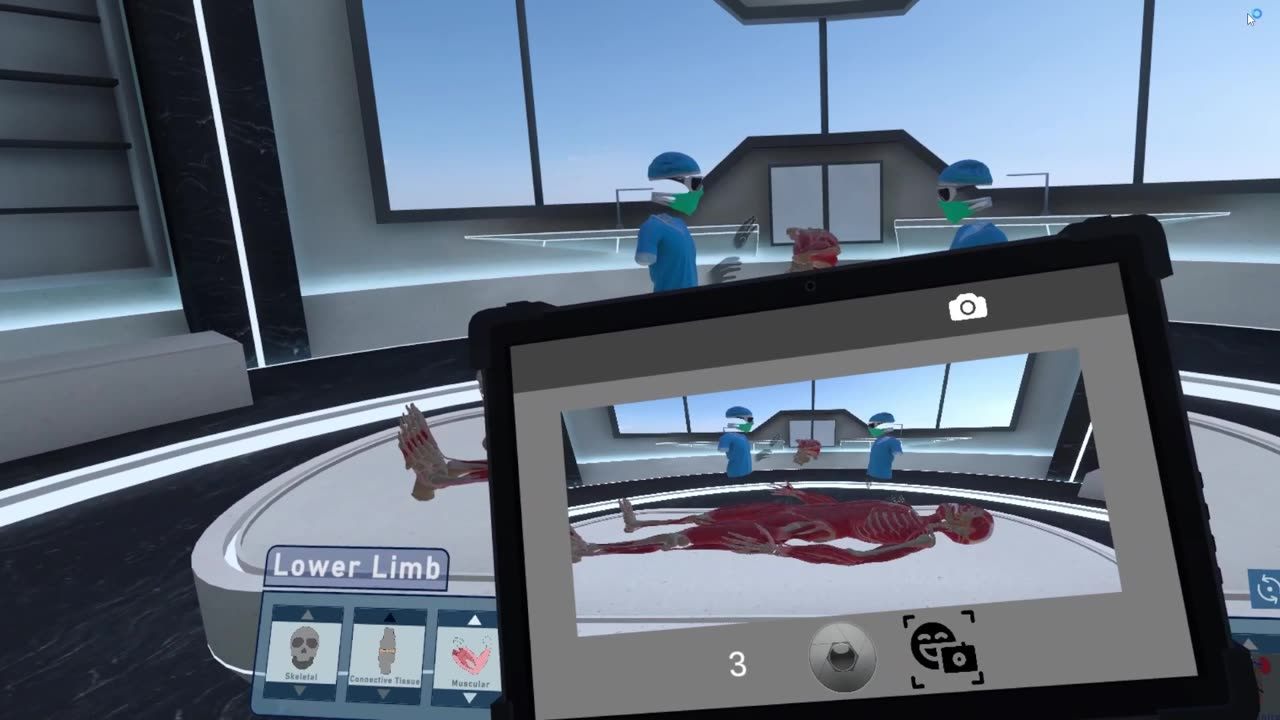
Then systemic. Within each piece, you work by system: 12 of them, from skeletal and muscular, through the vessels, nerves and organ systems, out to the skin.
Muscular, arterial, venous and nervous each go several sub-layers deep. Every layer toggles on and off on its own, across the whole body, down to individual organs.
The panel is context sensitive. Detach a leg and it reads "Lower Limb". One icon per system. Systems that don't exist in that segment are greyed out. Small up/down arrows step through the sub-layers.
Pipeline and rigging
I didn't go head to toe. I worked part by part and layer by layer, in parallel.
The heart got priority for the demo: its own detailed model, its own rig, a beating animation. The skeleton got a rough full-body rig early, so we could prove the system worked while muscle detail kept getting refined. Optimization happened while modeling, not as a cleanup pass at the end.
Skeleton rig. Muscle rig. Custom muscle bulge and deformation, done in the rig, not with Unity physics. A heartbeat cycle. Walk and run cycles, there to show the muscles deforming in motion.
The early version was a full-body, weight-bearing rig. Pull the hand and the pelvis shifts, and the weight redistributes across the body.
From V1 to the MVP
V1: a standing body, built around the weight-bearing rig and a different content vision. After the dissecting room visit, our internal SMEs pushed for something closer to the real thing: a room that feels like a dissecting room, a proper table, and the body lying in the position it would actually be in, so a session works the way it does there. That's what moved us from standing to lying down.
The MVP: a dissecting room, modernized rather than literal, with the body on a table. Users separate it into regions: the upper and lower limbs, the trunk (upper and lower) and the head. Then they toggle layers on each piece.
The weight-bearing rig was the fun part. It didn't get cut, just parked, so the MVP could stay focused on the atlas, which is what students need most. The rig works, and it's planned for the room once the final atlas and its muscle simulation are ready, for the later syllabus.
The UX problem
Nesting raises a question fast. If I grab the arm, does the hand come with it? What if I only want the hand?
We settled on a parent-child hierarchy. Pull the whole arm and the forearm and hand follow. Grab just the hand and you isolate it without disturbing the rest. We locked that in before MAAES. I won't pretend it was perfect.
The same hierarchy is what makes the "collaborative" part real. Because every piece is its own node, several students can work on different parts of the same limb at once. One on the hand, one on the forearm, without fighting over the whole arm. That was the point: a shared body, not a turn-based one.
If two students reach for the same piece, the first hand to grab it gets it. From there they can pass it to each other, the way you'd hand something across a lab bench.
This part was a group effort. I contributed to the flow design and the testing sessions with users and educators.
Outcome
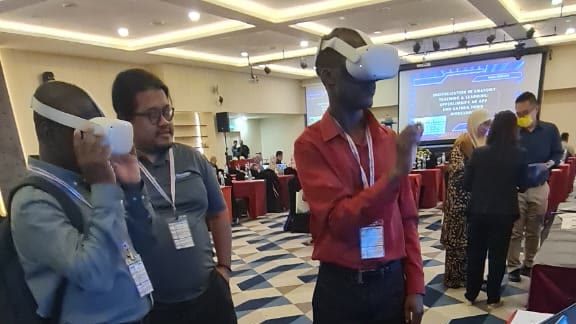
The MVP was signed off in May 2023, and we demoed it at MAAES 2023, the 2nd Malaysian Anatomical Association Education Symposium, in Kota Bharu on 29–30 August 2023. Real doctors and anatomy educators, hands on.
I was on site running demos. The doctors were impressed by the detail, and they also corrected it on the spot: things missing, things wrong. The educators told us how it did or didn't fit the way they teach. All of it went back to the SMEs for review and into one last update after the event. That's where the project stopped. It's on hold as a proprietary product, with no restart date.
Reflection
Two lessons stuck. Set the performance budget before you build: the arm rig proved that the hard way. And get the experts in early: the doctors caught what no book or app could.
What I didn't expect was how much I'd enjoy the conversations. At MAAES and in the SME review sessions, I got to talk directly with doctors and lecturers. They walked me through the ethics, their hands-on experience, and anatomy in far more depth than any textbook. I learned as much from those talks as from the build.
The project's on hold, but those habits, and that curiosity, came with me.